
Pack a tight capsule wardrobe with a small set of pieces, wear your blazer and heaviest shoes on travel day and keep one full outfit plus your essentials in your personal item. That single rule covers most of what makes one bag work trip outfit planning actually work. The rest is just execution.
Here’s your instant checklist to get started:
- Blazer (worn on travel day, not packed)
- 2 trousers or skirts in coordinating neutrals
- 3 tops in your chosen palette
- 1 dress or additional bottom for evening flexibility
- 2 shoes (one pair worn, one packed in a shoe bag)
- Lightweight layer (cardigan or packable knit)
- Toiletries in 3.4 oz (100 ml) containers per TSA rules
- One full outfit + essentials in your personal item
Stick to a two-neutral color story, choose wrinkle-resistant fabrics, and map every piece to your calendar rather than packing “just in case.” That’s the whole system.
Table of Contents
- What rules make a one-bag work capsule actually work?
- Sample capsules for every trip length
- Outfit formulas for every work-trip context
- How to fit everything into one bag
- How to map your capsule to your calendar
- What to swap for different climates and offices
- Laundry strategy and quick refresh techniques
- What to buy (and what to skip) for one-bag work travel
- Key Takeaways
- The one thing most packing guides get wrong
- Ilovenichewear has the travel-ready pieces your capsule needs
- Useful sources and further reading
What rules make a one-bag work capsule actually work?
A tight color story is the foundation. Pick two neutrals, navy and charcoal, black and tan, or grey and camel, then add one accent (a burgundy scarf, a cobalt blouse). Every top works with every bottom, and you never open your bag to a pile of pieces that don’t talk to each other. A cohesive color story and double-duty pieces produce far more outfit permutations than adding single-use statement items ever will.
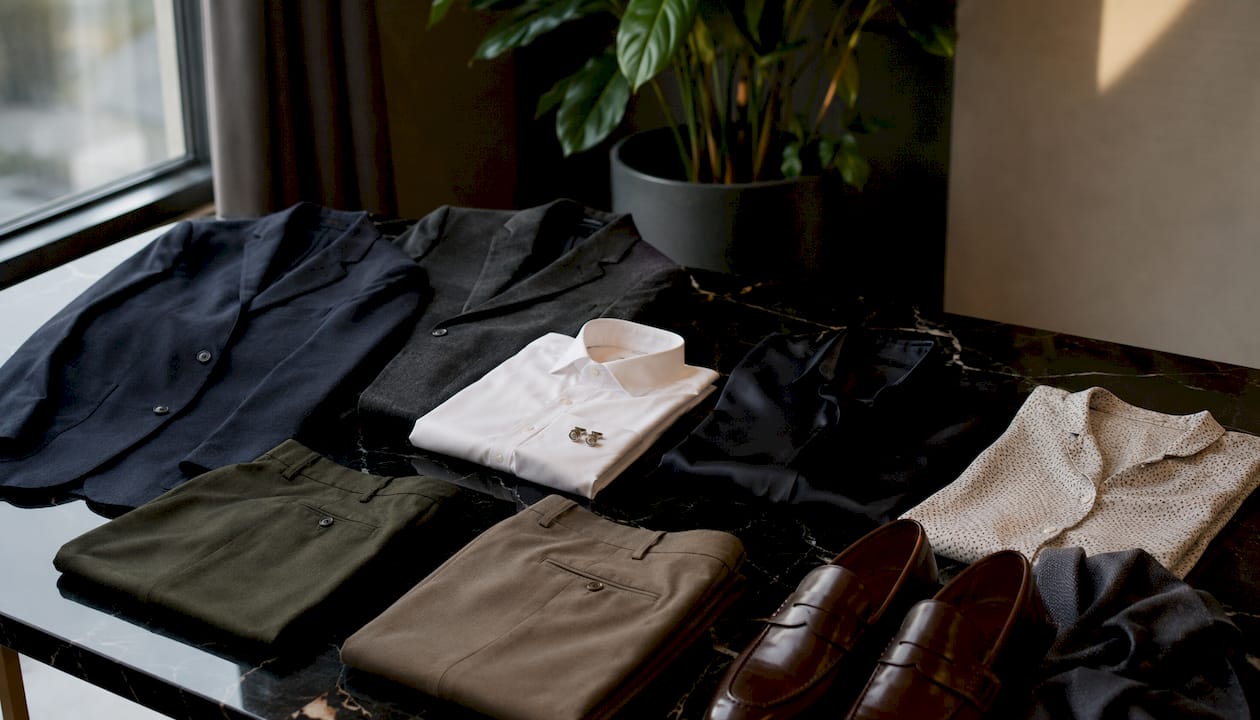
Silhouettes matter almost as much. Choose 2–3 complementary shapes: a tailored jacket, a streamlined trouser, and one flexible dress or skirt. These layer cleanly, photograph well on video calls, and shift from a morning meeting to a dinner without needing a costume change.
Fabrics are where most professionals leave money on the table. Merino and performance synthetics resist odor and creasing naturally, letting you wear a top two or three times before it needs washing. Avoid fragile silks unless you have a backup, and skip heavy cotton for anything you plan to rewear. Wrinkle-resistant blends and quick-dry fabrics are worth every extra dollar when you’re living out of one bag.
Layering solves the indoor climate problem. Conference rooms and offices run cold even in July, so a lightweight blazer or cardigan is non-negotiable. Think of it as three zones: a breathable base (top or blouse), a mid layer (lightweight knit), and a structured layer (blazer or travel jacket). The structured layer does the most work per ounce of any piece in your bag.
- Base layer: breathable top, moisture-wicking blouse, or fitted tee
- Mid layer: lightweight cardigan or packable knit for cold offices
- Structured layer: blazer or travel jacket (the formality lever)
- Accessories: one scarf, one belt, minimal jewelry to shift the look
- Shoes: 1–2 pairs that each do at least two jobs (loafers for meetings and dinner; clean sneakers for travel day and casual networking)
Pro Tip: A single wrinkle-resistant blazer provides the biggest formality lift for the fewest ounces of anything in your bag. It turns a plain top and trouser into a meeting-ready outfit in seconds. Check out Ilovenichewear’s wrinkle-free women’s blazer as a starting point.
Sample capsules for every trip length
Popular capsule templates range from a minimalist 7-piece baseline up to 15 or more pieces for week-long trips with varied events. The practical sweet spot for most professionals is 7–11 pieces, with 7 pieces as a minimalist baseline and 9–11 providing extra flexibility for longer or varied trips. Here’s how each size breaks down by category:
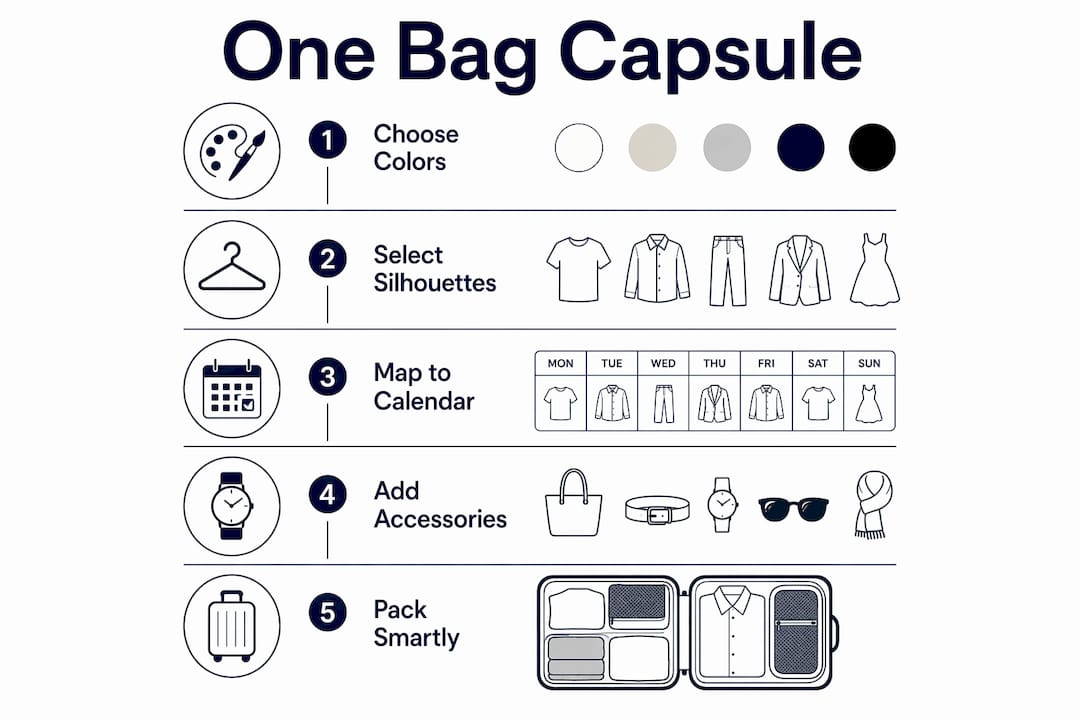
| Capsule | Blazer | Bottoms | Tops | One-Piece | Shoes | Layers | Accessories |
|---|---|---|---|---|---|---|---|
| 7-piece (minimalist) | 1 | 2 | 2 | 1 | 1 packed + 1 worn | 1 | 1 |
| 9-piece (compact) | 1 | 2 | 3 | 1 | 1 packed + 1 worn | 1 | 2 |
| 11-piece (flexible) | 1 | 3 | 4 | 1 | 1 packed + 1 worn | 1 | 2 |
| 15-piece (week+) | 1 | 3 | 5 | 2 | 2 packed + 1 worn | 2 | 3 |
Every capsule follows the same category logic: one structured layer, a set of bottoms, enough tops to rotate, one versatile one-piece, shoes, a lightweight layer, and a small accessory set. The numbers scale, but the logic stays the same.
Climate variants are simple one-swap adjustments:
- Warm climate: swap one trouser for a breathable dress, choose linen or moisture-wicking blends, add a lightweight scarf for air-conditioned rooms
- Temperate: keep the trouser, add a packable knit mid layer, choose a wool-blend blazer that handles both cool mornings and indoor AC
- Cool/cold: add a thermal base layer, swap the cardigan for a heavier knit, choose a wool-blend trouser over linen
For strict carry-on weight limits, some carriers enforce a 7 kg cabin limit on select routes. Wear your blazer and heavier shoes on travel day, and choose merino or technical fabrics to reduce how often you need to wash, which means fewer backup pieces packed.
Outfit formulas for every work-trip context
Dressing for a work trip gets easy when you treat each context as a formula, not a decision. Here are the five you’ll use most.
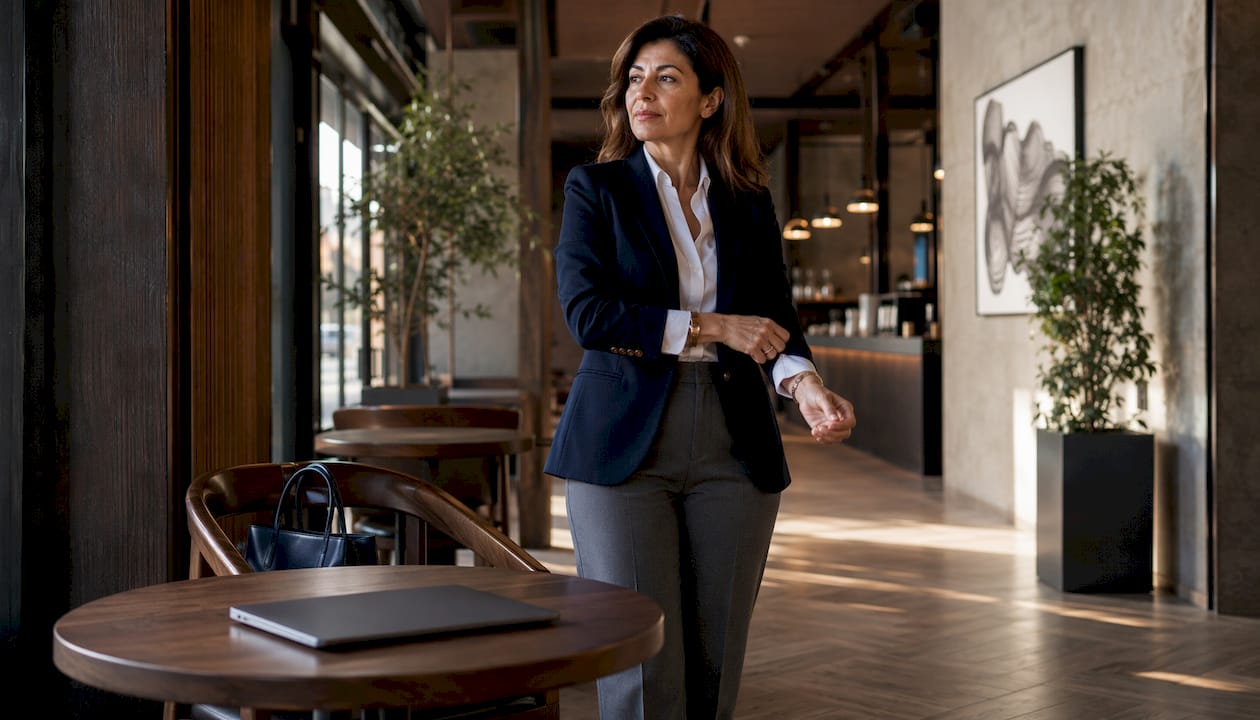
Meeting day: blazer + polished top + tailored trouser or skirt. To shift formality up, swap the top for a silk-feel blouse. To shift it down for a casual client lunch, remove the blazer and add a scarf. Same pieces, different energy.
Presentation: your most structured jacket or blazer + a top with a subtle pattern or a confident color + your best shoes. For video calls and stages, avoid busy prints and very pale colors that wash out under lighting. A fitted blazer in navy or charcoal reads authority on camera without trying too hard.
Casual networking or dinner: drop the blazer, swap your meeting shoes for loafers or a dressier flat, and add one accessory (a scarf, a statement earring, a belt). That’s three micro-changes that make the outfit feel intentional rather than recycled.
Travel day: comfortable base layer + worn blazer + one polished element, either loafers or clean leather sneakers. You want to arrive looking presentable in case your bag gets gate-checked and you walk straight into a meeting. The airport outfit guide from Ilovenichewear covers this in more detail.
Quick-swap cheat sheet: five micro-changes that create a fresh look from the same capsule:
- Change shoes (loafers → clean sneakers, or flats → block heel)
- Add or remove the blazer
- Swap the blouse for a fitted tee or vice versa
- Add a scarf or belt to a plain outfit
- Switch jewelry from minimal studs to a bolder piece for evening
How to fit everything into one bag
Organization is what separates a chaotic carry-on from one you can unpack in two minutes. Start with your personal item: pack one complete outfit, your laptop, chargers, medications, and toiletries. If your carry-on gets gate-checked, you can still make your first meeting.
- Lay out everything first. Put your full capsule on the bed and confirm every piece works with at least two others before it goes in the bag.
- Use packing cubes for categories. One cube for tops, one for bottoms, one for accessories and small items. Cubes keep things organized but don’t reduce airline weight, so weigh your loaded bag at home before you leave.
- Place shoes first. Shoes go at the bottom near the wheels (or the back panel of a backpack), each in a shoe bag to protect your clothes.
- Roll soft items, fold structured ones. Roll tees, knits, and casual trousers to save space. Fold blazers and tailored trousers along the seam, then place dry-cleaning plastic between layers to reduce friction and prevent creases.
- Use a garment folder or fold board for jackets. This keeps the shoulder shape intact and prevents the collar from collapsing.
- Fill gaps with soft items. Socks, underwear, and accessories fill the corners and gaps around shoes and cubes.
- Pack your refresh kit last, on top. Wrinkle-release spray (3.4 oz or under), travel lint roller, and a microfiber cloth pouch for glasses and small items go in an easy-access pocket.
Pro Tip: Keep tech, medications, and one full outfit in your personal item so a gate-checked carry-on can’t derail your first meeting. This is the single most useful habit for frequent business travelers.
Your essential packing kit: slim packing cubes, a garment sleeve or fold board, a travel lint roller, wrinkle-release spray under 3.4 oz, and shoe bags. A 30–40L business backpack or soft-sided carry-on gives you enough room for a 10–12-piece capsule without fighting overhead bin space.
How to map your capsule to your calendar
Mapping outfits to your calendar is the single most effective way to stop overpacking. Here’s the method in four steps:
- List every event on your itinerary. Include travel days, meetings, presentations, dinners, and any downtime. Be specific: “client dinner at a nice restaurant” is different from “team lunch at the office.”
- Sort by formality. Mark each event as high (presentation, formal dinner), medium (client meeting, networking), or low (travel, casual team lunch). Your highest-formality event gets your best outfit.
- Assign outfits from your capsule. Start with the most important event and work down. Use the quick-swap cheat sheet to vary looks across consecutive days without adding pieces.
- Build backups only when necessary. Add one extra top if you have more than two high-formality events back to back, or if there’s a significant climate shift mid-trip. Otherwise, trust the capsule.
Example itinerary mapping for a 3-day client trip:
- Day 1 (travel + client dinner): Travel day outfit (blazer worn, loafers) transitions to dinner with a shoe swap and added accessory. No outfit change needed.
- Day 2 (morning meeting + afternoon presentation): Blazer + polished blouse + tailored trouser for the meeting. Same trouser, swap blouse for a more structured top, keep blazer for the presentation.
- Day 3 (casual team lunch + travel home): Remove blazer, swap to clean sneakers, add a scarf. Travel home in the same comfortable base from Day 1.
That’s 7–11 pieces covering three full days with zero redundancy.
Pre-packing checklist (10 minutes):
- How many events, and what’s the dress code for each?
- Do I have an evening event that needs a different shoe or accessory?
- What am I wearing on travel day?
- Is laundry available, or do I need an extra top?
- Have I assigned every piece to at least one event?
What to swap for different climates and offices
A single capsule can handle most climate ranges with a few targeted swaps. The key is planning for the indoor environment, not just the weather outside. Offices and conference centers are often heavily air-conditioned even in warm destinations, so a lightweight structured layer is always worth the space.
Warm climate swaps:
- Replace one trouser with a breathable dress or linen-blend skirt
- Choose moisture-wicking or quick-dry tops over cotton
- Pack a lightweight scarf or cardigan specifically for cold indoor spaces
- Opt for breathable loafers or block-heeled sandals over closed leather shoes
Cool or cold climate swaps:
- Add a thermal or merino base layer under your tops
- Swap the cardigan for a heavier knit or wool-blend mid layer
- Choose a wool-blend trouser over linen or lightweight fabrics
- Pack a packable down vest if the forecast dips below 40°F
Transitional or mixed indoor/outdoor:
- Always include one lightweight blazer or structured cardigan regardless of the forecast
- Choose fabrics that breathe outdoors but look polished indoors (performance wool, ponte knit)
- For day/night temperature swings, layer a fitted turtleneck under your blazer instead of adding a separate coat
The layering logic stays the same across all climates: breathable base, optional mid layer, structured outer layer. You swap the weight and fabric, not the system.
Quick-reference for common scenarios:
- Hot destination, air-conditioned office: breathable dress + lightweight blazer in your bag
- Cold city, heated conference room: merino base + wool blazer, remove mid layer indoors
- Mixed forecast (60°F days, 45°F nights): ponte trouser + knit layer + blazer covers both
Laundry strategy and quick refresh techniques
For trips up to five days, a well-chosen capsule with merino or performance fabrics handles rewear without laundering. Merino tops can typically go two to three wears before washing; synthetic performance blends are similar. Cotton needs washing after every wear, which is why it’s the least efficient fabric for one-bag travel.
Quick refresh techniques:
- Sink wash: fill the sink with warm water and a travel detergent packet, hand wash delicate tops, roll in a small travel towel to remove excess water, then hang to dry overnight
- Bathroom steam: hang wrinkled garments in the bathroom while you run a hot shower; steam relaxes folds in 10–15 minutes without an iron
- Wrinkle-release spray: a 3.4 oz bottle of wrinkle-release spray smooths light creases in seconds; spray, smooth with your hand, and let dry for two minutes
- Hotel pressing: most hotels offer same-day pressing for a small fee; worth it for a blazer before a big presentation
For trips longer than five days, plan one laundry stop or add 1–2 extra tops. Hotel laundry services work for structured pieces; a local laundromat is faster and cheaper for basics.
Pro Tip: Pack a small sewing kit or a few safety pins for quick fixes, and a fabric shaver for pills on repeat-worn knits. These weigh almost nothing and save an outfit when you’re three days in.
Refresh kit checklist:
- Travel detergent packets (Soak or Scrubba work well)
- Silicone sink stopper
- Small travel towel (doubles as a drying mat)
- Portable clothesline with clips
- Wrinkle-release spray (3.4 oz or under)
- Safety pins and a small sewing kit
- Fabric shaver for knits
For anti-odor fabric care tips that extend rewear between washes, Ilovenichewear’s resource on anti-odor clothing covers the specifics well.
What to buy (and what to skip) for one-bag work travel
The pieces worth investing in are the ones that do the most jobs. A wrinkle-resistant blazer, one tailored trouser, one versatile dress, 1–2 high-quality tops in performance fabrics, and one pair of polished comfortable shoes cover the majority of work-trip scenarios. Everything else is optional.
Priority purchases:
- Wrinkle-resistant blazer or travel jacket: the highest-return piece in any work capsule. Look for ponte knit, performance wool, or a technical blend that holds its shape after being packed. A wrinkle-free women’s blazer that goes from casual to professional is the kind of piece that earns its place on every trip.
- One tailored trouser: choose a mid-weight fabric (ponte or performance wool) that doesn’t wrinkle and works for both meetings and dinner.
- One versatile dress: a fitted sheath or wrap dress in a neutral shifts from day meetings to evening with a shoe swap. It also packs flat and takes up minimal space.
- 1–2 performance tops: merino or technical blends in your palette’s neutrals. These rewear well, resist odor, and look polished under a blazer.
- One pair of polished comfortable shoes: loafers, block heels, or leather flats that work for meetings, dinner, and walking between venues.
Fabric guide:
- Merino wool: odor-resistant, wrinkle-resistant, temperature-regulating. Worth the premium for tops and mid layers.
- Performance blends (polyester/spandex, nylon/spandex): quick-dry, wrinkle-resistant, packable. Great for trousers and structured layers.
- Ponte knit: holds structure, doesn’t wrinkle, comfortable for long travel days. Ideal for blazers and trousers.
- Avoid: fragile silks without a backup, heavy cotton for anything you plan to rewear, linen for cold climates.
Fit checklist before you buy:
- Shoulder seams sit exactly at the shoulder point (especially for blazers)
- Sleeve length hits the wrist bone cleanly
- Trouser length works with the shoes you’ll actually pack
- No pulling or gaping at buttons or closures
Feature checklist:
- Pockets with zip or button closures for travel security
- Closures that don’t snag on other fabrics in the bag
- Linings that resist odor and moisture
- Packable or detachable collars and layers for space savings
Budget guidance: spend on the structured layer and shoes. These define how polished the whole outfit reads. Economize on basic tees and simple accessories, where quality matters less and replacement is easy.
For footwear and accessory recommendations that support minimalist travel wardrobes, Ilovenichewear’s guide covers the specific pieces worth adding to a one-bag capsule.
Key Takeaways
A two-color, 7–11-piece capsule mapped to your calendar is the most reliable system for one bag work trip outfit planning, and wearing your blazer on travel day is the single habit that makes it fit.
| Point | Details |
|---|---|
| Pack to your calendar | Assign every piece to a specific event before you pack; skip anything without a designated purpose. |
| Use a two-color capsule | Two neutrals plus one accent maximize outfit permutations without adding pieces. |
| Wear your blazer and heavy shoes | Wearing your structured layer and heaviest shoes on travel day saves space and keeps you under cabin weight limits. |
| Keep one outfit in your personal item | A gate-checked carry-on can’t derail your first meeting if your personal item has a full outfit and essentials. |
| Ilovenichewear for travel-ready pieces | Ilovenichewear’s wrinkle-free blazer and performance tops slot directly into a one-bag work capsule. |
The one thing most packing guides get wrong
Most business travel guides focus on what to pack. The smarter question is what to leave out, and that answer only comes from your calendar.
The conventional wisdom says to bring “versatile pieces.” That’s true, but it’s incomplete. Versatility without a plan still leads to overpacking, because “versatile” becomes a justification for every piece that might work rather than every piece that will work. The calendar-first method flips this. You start with your itinerary, not your closet, and you pack backward from your schedule.
The other thing guides underestimate is the indoor climate problem. A lightweight blazer in your bag isn’t optional when you’re headed to a conference in Miami in August. Those rooms are cold. Skipping the structured layer to save space is the mistake that leaves you shivering through a three-hour session and looking less put-together than you planned.
One more thing worth saying: the fabric decision matters more than the outfit formula. You can have the perfect capsule on paper and still end up with a wrinkled, odor-prone mess by day two if you chose the wrong materials. Merino and performance blends aren’t just a nice upgrade. For one-bag travel, they’re what make the whole system work without a laundry stop every other day.
The role of a capsule wardrobe in business travel goes deeper on this if you want to build a system that holds up across multiple trips, not just one.
Ilovenichewear has the travel-ready pieces your capsule needs
If you’ve read this far, you know the pieces that do the most work in a one-bag work capsule: a wrinkle-free blazer, a versatile dress, and a couple of performance tops that rewear without complaint. Those aren’t easy to find in a regular store, but they’re exactly what Ilovenichewear is built around.
The wrinkle-free women’s blazer at Ilovenichewear is designed to go straight from your bag to a boardroom without an iron. It’s the kind of piece that earns its spot in every capsule, whether you’re packing for two days or two weeks. Pair it with a performance top and a tailored trouser from the collection, and you have the core of a 10-piece capsule that handles meetings, dinners, and travel days without a second bag. Browse the full collection at Ilovenichewear and build your next work trip capsule from pieces that are actually made for the road.
Useful sources and further reading
These are the primary sources used throughout this guide, with notes on where each one is most relevant:
- TSA Liquids Rule (tsa.gov): The official source for the 3.4 oz (100 ml) liquids limit. Cite in the BLUF checklist and toiletries guidance.
- Business Trip Packing Essentials (Travel Vient): Covers the 7 kg cabin weight enforcement, wearing blazer on travel day, and the dry-cleaning plastic wrinkle trick. Used in packing techniques and capsule sections.
- Business Trip Packing List (JourneyBot): Source for the personal-item strategy (one full outfit + essentials). Used in BLUF and packing techniques.
- 12-Piece Work Trip Capsule Wardrobe (Uniqistic): Supports capsule size guidance and the color-story principle. Used in capsule templates and core principles.
- Office Outfit Survival Guide (Christina Tumminello, Substack): Justifies the calendar-mapping method and the “just in case” overpacking problem. Used in calendar mapping and BLUF.
- 3-Day Business Trip Without Checking a Bag (Inside Travel): Supports fabric recommendations (merino, performance blends) and short-trip packing formulas. Used in fabric guidance and capsule templates.
- Business Trip Packing List (Deep Arrival): Source for the indoor climate control rule (always pack a structured layer). Used in climate adaptation and core principles.
- Packing Light for Business Travel (Booking.com for Business): Covers the 5-4-3-2-1 packing rule and capsule wardrobe logic for business travelers. Background reference for capsule structure.
- Ilovenichewear Capsule Wardrobe Guide: Brand resource on capsule sizing and business travel dress codes. Useful for deeper reading on building a repeatable system.