
A shaping brief is a short, focused document that defines a project’s scope and solution concept before any building begins, while a shaper is the person responsible for creating that document. Understanding what does shaping brief versus shaper mean matters most when you’re working inside product development or creative project workflows. The two terms come from the Shape Up methodology, developed at Basecamp, and they describe two distinct things: an output and a role. Confusing them leads to unclear ownership, vague project boundaries, and wasted effort. Get the distinction right, and your team moves faster with less friction.
What does a shaping brief include?
A shaping brief is a 1–2 page document that crystallizes four things: the problem, the appetite, a rough solution sketch, and explicit exclusions. Each element does specific work. The problem statement explains why the project matters. The appetite sets a fixed time budget, not an estimate, for how long the team will spend on it. The rough solution sketch gives builders just enough direction to start without locking them into a single approach. The exclusions list what is deliberately out of scope.
The shaping brief definition is not a spec sheet. It does not include wireframes, detailed user stories, or technical requirements. That level of detail comes later, during the building phase, when the team owns the work. The brief’s job is to frame the problem and solution at a high level so decision-makers can evaluate whether the project is worth pursuing.
Here is what a typical shaping brief covers:
- Problem statement: What is broken or missing, and who is affected?
- Appetite: A fixed time box, such as two weeks or six weeks, that the solution must fit within.
- Rough solution sketch: A fat-marker sketch or simple diagram showing the core concept.
- No-gos: Features or approaches explicitly ruled out to prevent scope creep.
Shaping briefs differ from creative briefs in a key way. A creative brief inspires a creative team with a single-minded proposition and emotional direction. A shaping brief frames feasibility and scope for builders. Marketing briefs run longer, typically 2–4 pages, while shaping briefs stay tight at 1–2 pages.
Pro Tip: Write your no-gos before you write your solution sketch. Knowing what you are ruling out forces you to be honest about what the brief actually commits to.
Who is a shaper and what do they do?
A shaper is typically a senior product leader, product manager, or experienced designer who defines the work before a team receives it. The shaper role sits upstream of execution. Shapers do not manage the team during building. They define the problem space and solution concept so the team can work with real autonomy.
The shaper’s core responsibilities look like this:
- Set the appetite: Decide how much time the project deserves, not how long it will take.
- Sketch the solution: Produce fat-marker sketches that show the concept without over-specifying it.
- Identify risks: Spot the parts of the solution that could blow up the timeline before the team starts.
- Define boundaries: State clearly what is in scope and what is not.
- Collaborate with stakeholders: Gather enough context to frame the problem accurately.
The shaper does not estimate task durations. That distinction matters. Estimation is a team activity during building. The shaper sets a fixed time budget and then shapes a solution that fits inside it. If the solution cannot fit the appetite, the shaper revises the concept, not the timeline.
A common misconception is that the shaper micromanages. The opposite is true. Shapers give teams a clear frame and then step back. The brief is the handoff. After betting, the team owns the work entirely.

Pro Tip: If your shaping brief requires a team to ask you five clarifying questions before they start, it is not shaped enough. A well-written brief should answer the most likely questions before they are asked.
How shaping briefs and shapers work inside Shape Up
Shape Up, Basecamp’s alternative to Agile sprints, replaces backlogs and velocity with three distinct phases: shaping, betting, and building. Each phase has a clear owner and a clear output. Understanding the flow makes the shaping brief’s role obvious.
The three phases work like this:
- Shaping: The shaper defines the problem, sets the appetite, sketches a solution, and writes the pitch, which is the shaping brief.
- Betting: Senior stakeholders review shaped pitches and decide which ones to commit to in the next cycle.
- Building: A small team receives the shaped brief and builds the solution within the fixed time box, with full autonomy.
The shaping phase uses six-week cycles instead of two-week sprints. That longer window gives shapers enough time to think through problems properly before committing team resources. The betting table is where shaped pitches either get funded or get dropped. Nothing enters building without passing through shaping first.
“Shaping defines what is included and explicitly excluded to prevent scope creep. The shaped pitch is not a backlog item. It is a complete concept with defined boundaries, a fixed appetite, and identified risks ready for a team to execute.”
Ryan Singer, who developed Shape Up, draws a clear line between framing and shaping. Framing is stakeholder buy-in. Shaping is the detailed work of defining solution mechanics and risks. Both matter, but they are separate activities. Mixing them produces briefs that are either too vague to act on or too detailed to leave room for team judgment.
How shaping briefs differ from other project briefs
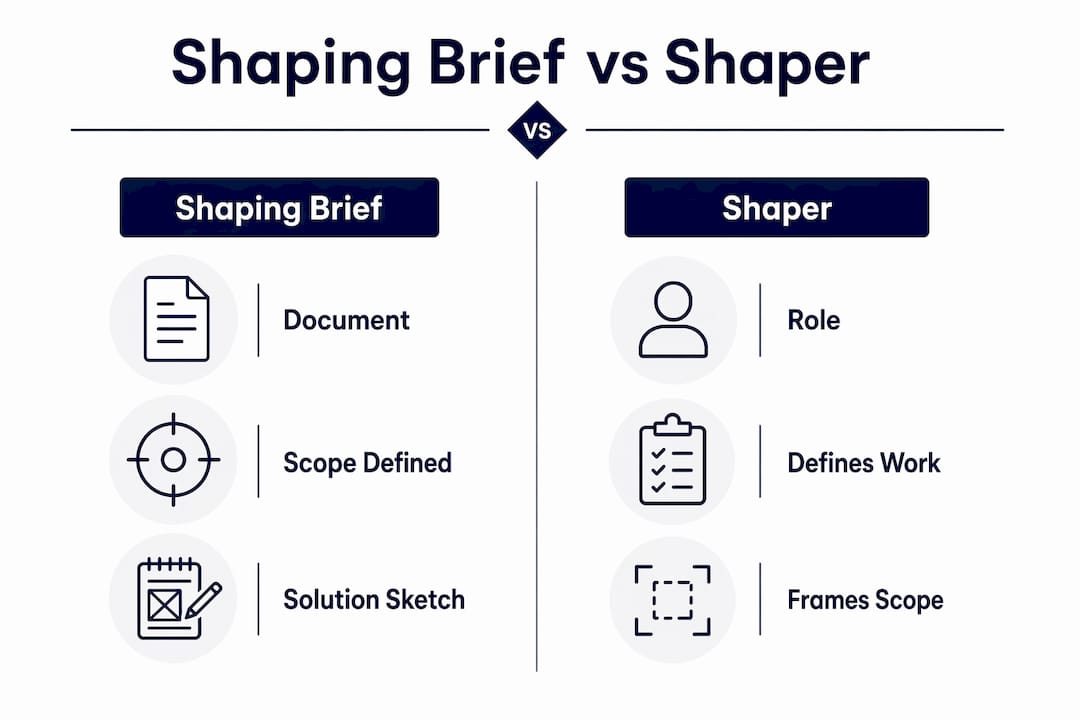
The meaning of shaping brief becomes clearer when you place it next to the other brief types you may already know. Three documents often get confused: the shaping brief, the creative brief, and the marketing brief.
A creative brief inspires. It gives a creative team a single-minded proposition, a tone, a target audience, and an emotional direction. It does not define technical scope or time budgets. A marketing brief is longer, typically 2–4 pages, and covers campaign goals, audience segments, messaging strategy, and success metrics. A shaping brief does neither of those things. It frames a product or feature problem and proposes a bounded solution concept for builders.
Key differences at a glance:
| Brief type | Primary audience | Core purpose | Typical length |
|---|---|---|---|
| Shaping brief | Builders and decision-makers | Define scope and solution concept | 1–2 pages |
| Creative brief | Designers and copywriters | Inspire creative direction | 1–2 pages |
| Marketing brief | Marketing teams | Outline campaign strategy | 2–4 pages |
Some workplaces blend elements of shaping briefs and creative briefs, especially in agencies where product and creative work overlap. That hybrid can work, but only if the document clearly separates scope decisions from creative inspiration. Mixing the two without clear labels creates confusion about what the team is actually being asked to decide.
Shaping briefs sit upstream of creative briefs in most workflows. The shaping brief answers “what are we building and why?” The creative brief answers “how should it look and feel?” Both questions matter. They just belong in different documents.
Practical tips for writing briefs and acting as a shaper
Writing a strong shaping brief and acting as an effective shaper are two skills that reinforce each other. Here is what works in practice:
- Keep the brief to two pages maximum. If you need more space, the solution is not shaped yet. You are still in discovery.
- Write no-gos explicitly. Defining exclusions is as important as defining the solution. Teams interpret silence as permission.
- Use fat-marker sketches, not wireframes. A rough sketch communicates the concept without locking the team into your implementation idea.
- Set the appetite before you sketch the solution. The time budget should shape the solution, not the other way around.
- Separate risks from the solution sketch. List the parts of the concept that could fail or expand unexpectedly. Teams need to know where to be careful.
The shaper role requires comfort with ambiguity. You are not writing a specification. You are writing a frame. The team will fill in the details. Your job is to make sure the frame is solid enough that they can do that without coming back to you every hour.
Pro Tip: Read your brief out loud before you share it. If any sentence requires a follow-up explanation, rewrite it. The brief should stand on its own.
Key Takeaways
A shaping brief is the output; the shaper is the role that creates it, and keeping those two things separate is what makes Shape Up projects run cleanly.
| Point | Details |
|---|---|
| Shaping brief definition | A 1–2 page document covering problem, appetite, solution sketch, and no-gos. |
| Shaper role | A senior product leader who frames work before teams receive it, without micromanaging. |
| Appetite vs. estimate | Shapers set fixed time budgets; teams do not estimate duration inside a shaped brief. |
| Brief types differ | Shaping briefs define scope for builders; creative briefs inspire designers with direction. |
| No-gos are required | Explicitly listing out-of-scope features prevents scope creep and team misinterpretation. |
Why this distinction changed how I think about project clarity
The confusion between shaping brief and shaper is more common than most project teams admit. People use the terms interchangeably, and that small mistake creates real problems. When a team does not know who owns the shaping work, the brief either never gets written or gets written by the wrong person at the wrong level of detail.
What I have seen repeatedly is that teams skip the shaping phase because it feels like extra work before the “real” work starts. That thinking is backwards. The shaping brief is what makes the building phase fast. Without it, teams spend their first week figuring out what they are actually building. With it, they start on day one with a clear frame and real autonomy.
The shaper role also gets misread as a project manager role. It is not. A project manager tracks progress during execution. A shaper defines the work before execution begins. Those are fundamentally different jobs, and mixing them produces briefs that are either too controlling or too vague to be useful.
The detail level in a shaping brief is the hardest thing to get right. Too little, and the team is lost. Too much, and you have written a spec that removes their ability to make good decisions. The fat-marker sketch concept from Shape Up is the best mental model I have found for this. Draw the concept with a thick marker. You can show the shape without showing every line.
Understanding the difference between shaping terms like brief and shaper is the first step toward running projects where teams feel trusted and work actually ships on time.
— I
Niche finds for creative thinkers at Ilovenichewear
Creative and project-minded people tend to care about more than just their work. They care about how they show up, how they feel, and what they wear while doing it.

Ilovenichewear curates apparel for people who think differently and dress with intention. Whether you are heading into a creative session or a casual Friday meeting, the shop’s full collection has something comfortable, stylish, and a little unexpected waiting for you. From breezy boho blouses to wrinkle-free blazers that go from desk to dinner, every piece is picked with real life in mind. Free shipping on all orders makes it easy to try something new without the second-guessing.
FAQ
What is the difference between a shaping brief and a shaper?
A shaping brief is the document that defines a project’s scope, appetite, and solution concept. A shaper is the person who writes it.
What does a shaping brief include?
A shaping brief includes a problem statement, a fixed time appetite, a rough solution sketch, and a list of no-gos that define what is out of scope.
Is a shaper the same as a project manager?
No. A shaper defines work before a team starts building. A project manager tracks progress during execution. The roles operate at different stages of a project.
How is a shaping brief different from a creative brief?
A shaping brief frames scope and solution feasibility for builders. A creative brief inspires designers and copywriters with direction, tone, and a single-minded proposition.
What is the appetite in a shaping brief?
The appetite is a fixed time budget set by the shaper. It defines how much time the project deserves, not how long the team thinks it will take.